

Consolarium blog
 Over the past few years the Consolarium team has invested in a variety of technical/digital equipment that it wanted to explore in relation to how its effective and innovative use could impact favourably and positively on teaching and learning contexts in settings from 3-18 years.
We have been thinking how best we can utilise this ‘cupboard of super stuff’ and how it can be out in schools helping teachers teach and children learn rather than not doing that! After some thought we came up with the idea of establishing a loan service that Scottish teachers could access via Glow - this is what we are now calling CPDConsolarium. Based on the excellent leading work of Con Morris and the CPDCentral team we have designed a community of practice that aims to act as the focal point for teachers to share their experiences, successes and challenges in using GBL, game design and other technologies in their practice.
We have an inventory of over 220 assets that can be loaned by any teacher that joins CPDConsolarium. Before they do this they must first of all join the community by filling in the online membership form. Once this is done they can then browse the searchable catalogue and see what resources are available and when they can loan them. If a resource is free then a bid is submitted. This is an important part because we are asking teachers to begin to reflect on how they plan to use the resource, what impact they anticipate on learning as well as what it means for their own professional development in relation to how the Standard for Full Registration is being addressed by their work in this area. Once submitted it goes through an approval process which can involve e-mails, phone calls to the school or Twitter DMs by myself to the bidder in order to iron out any problems and to get the resource out to schools.
However, any bid that is accepted comes with a blank wiki page dedicated to that teacher and the resource that they have loaned and an expectation that the developing narrative of their experience will be documented and shared with everyone else. Without agreement to this no kit is sent out.
Some of the kit that is available includes:
Already the community is growing and we have already approved quite a number of sets of kit.
This resource is here for any Scottish teacher who can access CPDConsolarium with their Glow account. It is our resource, for us to use and to help inform each other of our developing practice. Come and join and empty my cupboard of superb stuff!
 A few months back I featured the work of Bernadette Donald from Dundee who was involved in the Land of Me pilot project. She was inspired by the idea that a digital game such as Land of Me was designed to encourage enquiry and learning away from the digital screen, possibly more than actually from it. The context of creating an intrepid explorer mindset, inspired by Eric, Buddy Boo and Willow, in young learners is something that appears to have appealed to many teachers who have been involved with this pilot - including the team at Port Ellen PS.
Outdoor Explorer Logbooks
In order to exploit the children’s heightened levels of curiosity and willingness to explore the outdoor environment and in order to yet again involve parents in the children’s learning the class teacher devised an idea that involved the creation of an outdoor adventurer pack. This pack included:
There were four of these packs available to the children to take home so that they could go out into their own environment and explore! The logbooks were packed full of photographs, drawings, stories and information about Islay and the various creatures that can be seen there. One boy even reported seeing an eagle on the roof of the Laphroaig Distillery! A whole host of artefacts were discovered and brought in by the ‘Little Explorers’ and the display table found itself festooned with antlers, shells, broken bird’s egg cases and even an empty wasps’ nest!
As with the earlier post about making outdoor dens in the forest from the school in Dundee the teachers at Port Ellen PS talked glowingly about the impact that this experience and what the overarching context was doing for the children involved. In particular the teachers commented on:
Thank you
Now that we have come to the end of this pilot we would like to take the opportunity to thank the people at Land of Me for supporting our pilot projects and to all the staff, children and parents from Dundee, West Lothian and Argyll & Bute for making so much of what we have done such a positive experience.
When I first chatted with Janice McRae about her plans for using The Land of Me one of the first things she made reference to was her desire to encourage parental involvement in the project. Having a strong belief that parents should be as good a partner as possible in helping children learn she was very keen to create ways in which this could happen. A letter of information was sent out to all parents asking for help with building some of the class scenes as well as telling them about the opportunity to come and in to the classroom to support some learning activities.. This desire is very much in concert with that of Scottish Government’s views on parental involvement:
Parents who take on a supportive role in their child’s learning make a difference in improving achievement and behaviour. The active involvement of parents in the life of the school can help promote a learning community in which pupils can engage positively with school staff and their peers.
I was keen to get an overview from some parents about what their perception of this project had been and what impact, if any, they felt that it had had on their children. One mother I spoke to talked of her delight at being asked in to the classroom to help in the first place but also of her sense of amazement at the spread and range of
 curricular activity that was happening. She also commented on the information letter that went home from the school being something that immediately captivated her attention and at her delight of how the project helped make relevant learning about her daughters own community and environment.
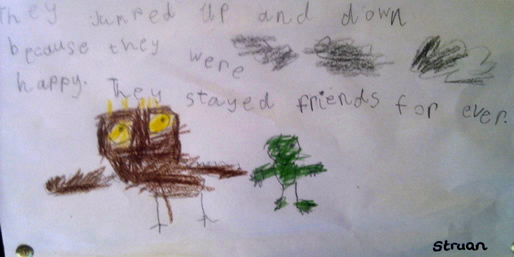
On the day that I visited the class a writing activity had been planned that involved parents coming in to help the children with a story about the characters in The Land of Me. There were quite a number of parents in the room that day and the atmosphere was focused and industrious. Following on from the stories that can be read when the player/learner visits Granny Olive in The Land of Me the guidance given to the children and the teacher was
 that their story would be in three parts, would contain one of the main characters from The Land of Me and that it would have either a happy, sad or funny ending. The parents acted as scribes where appropriate and worked with their child to encourage the telling, drawing and writing of their own Land of Me story.
I also took time to interview some of the parents that took part in this writing session. The parents were hugely impressed with the open and visual nature of the learning environment and they were delighted to be playing such an active part in their children’s learning in school as well as out of school.
Parent Interview 1
Some of the points of made by this parent about this experience included:
“This approach to learning is completely different, it really leaves it open to their imagination.”
“The reading, the writing and the arithmetic is all in here..the kids are making it all themselves.”
“It’s been great getting in here and seeing them working…the classroom is so vibrant and busy!”
Parent Interview 2
Some of the points of made by this parent about this experience included:
“This is fantastic, lovely…I like that we’re involved in it all.”
“It’s fantastic because they can get so involved in it. It’s not like just picking up a book and putting it away-they are part of it every day.”
“My husband and I coming to help has been significant for us…we know what she is talking about when she comes home because we have been involved.”
Port Ellen PS clearly view the parents of their children as a valuable resource and as allies in helping to take children forward. It was clear from my discussions with the parents that such willing encouragement for them to be part of the life of learning really made them feel god about being a partner in their child’s development. What I saw in my time there is testament to this approach-happy children and happy parents working together with thoughtful and committed teachers in a vibrant and inquisitive learning space.
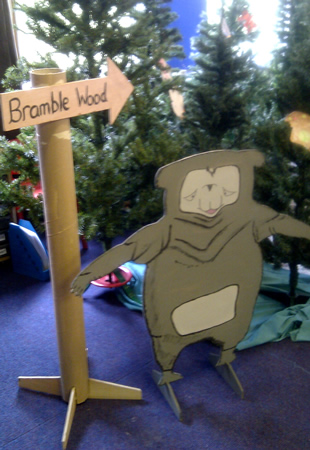 There has been much discussion over the past few years about the nature of learning spaces and how these should be designed in order to effect the best conditions for learning. This was something that I reflected on during and after my visit to P.1/2 at Port Ellen PS having seen a traditional rectangular classroom being transformed in to a magical place where adventure and learning happened.
Working with parents the class teacher at Port Ellen PS designed and made a number of areas that matched those in the The Land of Me. Each area had many references to the characters and themes running through the chapters in the software but also to a range of other contexts for learning and development. What was clearly evident though in my visit was the way in which the children had completely immersed themselves in the learning space that was their traditionally shaped classroom - and in so doing they had lost themselves in learning.
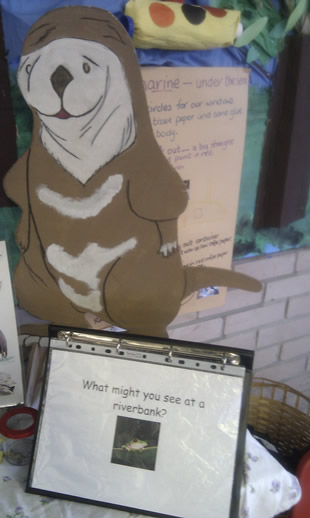
Dancing with otters at the riverside
I spoke with one young pupil about the area that had been set up as the riverbank. I was introduced to Dodo the Scottish Otter who I was told liked to dance. Dodo had a number of dance moves that the children had been
 learning and putting together in sequences and they had been making their own too. I also saw that the children had been learning all about creatures that might live in or near the riverside and that they had been outside adventuring and learning about creatures that lived on their island. I will go in to further detail about curricular activity and CfE references in a later post but at this stage the gleeful look on this learners face in this accompanying video says a lot about how learning can be positively influenced by such a motivating and exciting learning space in which one can learn!
Reading in the cave
Classrooms sometimes have very comfortable spaces that are designated for reading. Spaces where children can relax on comfortable cushions or a nice carpet and take time to read. The take on this reading space during this project was structured around Granny Olive’s cave. This is the storytelling place in The Land of Me and it is a
 calm and peaceful place where stories are brought to life by a very old giant tortoise. This video shows a young learner being interrupted by me when he was quietly reading The Stick Man. Listen to what he says and then watch how he engages with his book as I move away with the camera. Yet again, we see a thoughtful learning space situated in a meaningful context that appears to be having a positive impact on encouraging good learning; in this case independently-chosen reading time.
Classrooms, particularly those in Primary schools, are often transformed to mirror or ‘become’ the context in which learning is situated at particular times. When they are done well they can impact in a positive fashion on teaching and learning. As we can see from the work at Port Ellen PS the effort can be very worthwhile indeed.
The team at the Consolarium first saw The Land of Me when it was being presented at a game based learning conference in London. We were quite enchanted by the resource and felt that it could be something that, if used appropriately, could work well to support and enhance learning with younger children. We managed to meet up with James Huggins who is the CEO of Made in Me, the company that make the software and let them know that we would be interested in running pilots when the resource was ready to go…

Discussions continued with James and his team and eventually we managed to get things on the move. However, this was not where things stopped in terms of partnership with Made in Me. Very keen to see for himself how things had been going on in Scotland he asked if he could accompany us on out visit to Port Ellen PS to see for himself how his resource was being used in a teaching and learning context.
Once Janice McRae heard that James Huggins was coming to visit she began to think how she could best exploit this event to have further impact on the chidren’s learning…and in so doing she came up with an idea!
The King of the Land of Me comes to Port Ellen PS.
Janice’s idea was to ask James Huggins to act as the KIng of The Land of Me when he came to visit. That meant that the children could write letters to the King telling him what they know about his fabled land. James was in agreement and soon enough a batch of hand-written letters found their way to the King of The Land of Me’s postbox. James took time to to respond to all the children’s letters and duly sent them back with a promise that he would come to see them in the classroom.

This was the catalyst for great excitement and following on from the Royal Wedding this year plans were put in to place to ensure that things would be ready for the Royal visit.
On arrival at the school James was asked to wear a crown and a cloak so that his persona as the King of The Land of Me could be as true as possible for the excited children. He readily went along with this and was somewhat at ease in his Royal role! As he entered the class he was given a guard of honour by the children who were acting as animals from his Kingdom. A red carpet then led to his classroom throne where he was then met by his loyal and admiring subjects.

I spoke with James later that day about what he had seen and what he thought of the way that his resource was being used. His first reaction was to say that he was ‘speechless’ and that “we could not have created a better example of why it is we made The Land of Me or how we’d like it to influence learning!”
You can hear our conversation below:
The craft of the teaching and the way in which contexts can be created to help learners suspend their disbelief is clearly in evidence here. Yet again we see how young learners can respond in such a positive fashion to this methodology and how the thoughtful and imaginative teacher can create the environment in which rich learning can happen and thrive.
 This year we worked with the people at The Land of Me to pilot their software in schools in Dundee, West Lothian and Argyll & Bute. We have already seen some great work in the use of this software to support and enhance learning in Pre-5 and P.1 & P2 classes in Dundee and West Lothian and were also made aware of work ongoing in some of the Argyll and Bute schools via a class blog and a Made in Me’s Facebook page.
Janice McRae from Port Ellen PS on Islay was one of the teachers who came along to the Land of Me introductory session in Inveraray earlier in the year. As a result of her experience on the day and following on from subsequent discussions with colleagues and her own thinking about the needs of her learners she has put together the most inspiring learning experience set in The Land of Me, one that has encouraged parental involvement in so many ways and that has created a space in which her pupils can suspend their disbelief and embark on a learning adventure!
“We had three weeks of learning before we even looked at the software!”
I managed to get out to visit Janice and her class just before the summer break to see just what had been happening. You can listen to my chat with her about how she planned to use the Land of Me and how things progress from then on…
Planning for learning
What was interesting about how Janice McRae planned to use the Land of Me resource was that in the first instance she did not share it with her children for three whole weeks. During this time so much was done in terms of asking questions and initiating discussions in order to create the context for enquiry and curiosity that could then be further developed when the resource was introduced. Some of the questions that were discussed included: Who lives in the Land of Me?; What is a map?; How would we get to the Land of Me? As a result of these discussions some of the children suggested that they make the Land of Me in the classroom!
“Let’s turn the classroom into The Land of Me!”
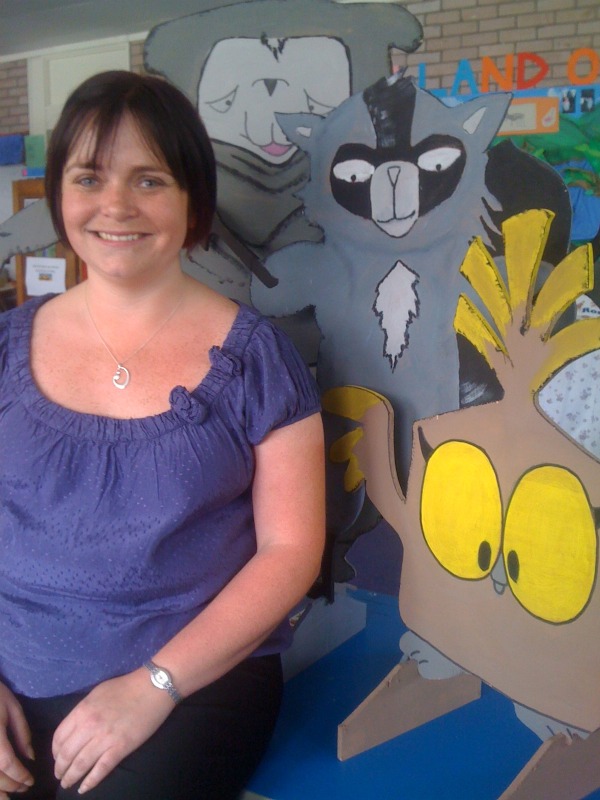
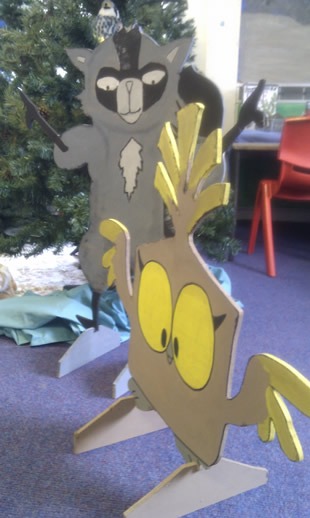 The Land of Me is made up of a number of chapters that are set in different geographical scenarios. We meet the main characters Buddy Boo, Eric and Willow in the desert, on clifftops, by the riverside, in the arctic and other places too. With the help of her partner and many of the parents Janice went about transforming the classroom into The Land of Me with all the scenes represented in the software physically incorporated into the classroom. Parents helped make camels for the desert, brought in trees for Bramble Wood, built the cave where Granny Olive reads her stories and even made wooden cutouts of the main characters from the story.
With things in place both contextually and physically it was now time to go on a learning adventure…
When we first began the Consolarium initiative way back in 2006 its main aim was to explore and share ways in which the use of computer games and game design could have a positive impact on teaching and learning and support Curriculum for Excellence in Scottish schools. Over the years this aim has remained the same and our reach across the country has been quite a success. Many of the ideas, approaches and methodologies we employed as well as many of the challenges that we faced in growing this practice became of interest to educational colleagues in England and further afield and this led to a number of invitations to speak at many conferences and other professional development settings. This wider recognition from colleagues outwith Scotland has played some part in affirming Learning and Teaching Scotland’s (now Education Scotland) ambitious and somewhat prescient decision to invest in and commit to such a venture back in 2006.
 One of the invites that we were able to accept and honour recently was from the Digital City events (part of the Futur en Seine Festival) in Paris. As part of a three part seminar programme organized by Le Group Compas, Cap-Digital and Microsoft we were asked to deliver a keynote talk about our work in leading game based learning in Scotland and also about what we have seen in terms of impact on learning.
The session was to be shared with Professor David Shaffer from Wisconsin University. Prof. Shaffer is the author of How Computer Games Help Children Learn and he is the person behind the Epistemic Games website. It was a delight to share the session with such an eminent GBL leader and as it turned out although we shared the same belief that games can help children learn, how we should go about this was slightly different…
Our main thrust in relation to games in schools has been to use commercially available games (COTS) that have been built for entertainment and not for education. Our reasoning behind this is embedded in James Paul Gee’s take on Semiotic Domains and the fact that so many computer games present challenging, demanding, complex and culturally appealing contexts for learning that schools can undoubtedly employ to great effect. Some examples include using these games in schools:
We have also worked closely and carefully with our Local Authority Education partners and schools in Scotland to ensure that our endeavours are always wholly based in sound pedagogic principles that would fit in with the established practices and workings of a classroom to some degree but that would also begin to challenge established mindsets regarding the nature of technology in learning, valuing and exploiting what children value in their own cultural domains and how effective learners can be independent of adult intervention.
Prof. Shaffer’s work with Epistemic Games focuses more on making bespoke games that would enable players to be professional people. This definition of Epistemic Games is offered on his website:
Epistemic games are computer games that can help players learn to think like engineers, urban planners, journalists, lawyers, and other innovative professionals, giving them the tools they need for a changing world.
In epistemic games, players see what it is like to live in the world of adults. They learn ways of thinking that matter in the digital age, and have a chance to imagine the kind of person they might someday become.
In essence Epistemic games such as Nephrotex, Urban Science, Digital Zoo and Sodaconstructor are designed in such a way that to play successfully the player has to situate themselves within the real life context of the job of being an engineer, urban planner or animator thus learning about AND applying the skills directly related to these positions.
Prof. Shaffer established a thread through his presentation that questioned the effectiveness of schooling in respect of learning being detached from the context of application of newly found and developing skills, knowledge and understanding. School needed to change to help learners reach their full potential and the application of Epistemic Games should be central to that change.
Both our presentations plus an introduction to the session from Julien Llanas, who chaired the session, can be viewed here.
The discussion session at the end of our presentations was particularly lively with an emphasis on some of what we had touched on in relation to metacognition, development of self-esteem and enhanced attitudes to being a learner and learning. Professor Daniel Andler from the University of Paris-Sorbonne was tasked with summing up the seminar session. As part of this summing up Professor Andler chose to focus on the different approaches that Prof. Shaffer and his team have taken. He compared us to the Mensheviks and the Bolsheviks with the Consolarium being observed to be the more moderate of the two in relation to trying to effect change from within established structures and attitudes but with Dr Shaffer looking for educational revolution on a much quicker scale!
Yet again it was a great delight to be able to share the vision and the innovative practice coming from of Scottish schools with colleagues in another country. We look forward to hearing how people such as Julien Llanas and other interested parties that we met in Paris make progress in the domain of game based learning In French schools as well as learning more about the work of the team at Epistemic Games.
This is the fifth of a series of 5 blog posts about the 1st Class Kidz Digital radio project that took place in Hatton Cruden PS. Introductory post can be viewed here.
 1st Class KIdz Digital not only bring you the best in modern day music, quick-witted DJs delivering comedy sketches and the best of local industries featured in high quality advertising. Oh no, as with any radio station they also bring you the news, the weather and sports bulletins in every show. I managed to interrupt the team who cover all these areas and got the lowdown on how they gather their material for broadcast on 1st Class Kidz Digital.
News Reporters
How do we manage to mix up serious and not so serious news so that it appeals to our listeners. Also, where should we source our news stories - BBC or Sky?
Sports Reporter
Exploring local sport stories, exploring minority sports and discussing controversial issues in sport such as that rugby punch!
Weather Reporter
How we go about gathering the weather report for out area and what it means to be the person giving the bad news about rain for the weekend!
Thank you once again to all at Hatton Cruden PS for allowing us to share this excellent project with everyone.
This is the fourth of a series of 5 blog posts about the 1st Class Kidz Digital radio project that took place in Hatton Cruden PS. Introductory post can be viewed here.
In relation to Enterprise in education the Curriculum for Excellence website argues that good enterprising teaching and learning should:
 The Advertising team at 1st Class Kidz Digital in Hatton Cruden PS had most certainly shown how they were addressing many of these aspirations (particularly the last three) with their efforts to attract local businesses to advertise on their school radio show. The local market and bakery both agreed to a deal that involved them supplying fruit and cakes in exchange for a well-scripted and well-crafted advert to feature on 1st Class Kidz Digital. I had a chance to speak with the Emily and Haley, who were the Advertising executives in the team, about their work:
Some good evidence here of a range of skills being applied in this task. Technical competence most certainly being developed as the children have been using Cool Edit to record and manipulate their adverts as well as writing poems/lyrics and negotiating business deals with local shops! Yet another effective team with the wider machine of 1st Class Kidz Digital.
This is the third of a series of 5 blog posts about the 1st Class Kidz Digital radio project that took place in Hatton Cruden PS. Introductory post can be viewed here.
 One of the most important ingredients in ant radio show id the presenter, or in the case of a music station, the DJs. I met with two sest of DJs at 1st Class Kidz Digital and chatted to both. First up are DJ Groove and DJ Tic-Tac. Have a listen to our chat:
These boys said a number of things during our chat that really chimed with me in terms of how this experience had impacted on them as learners. These phrases included,
“Mr Mier has given us the independence to work on this project”
“This radio project has made me look forward to coming to school, it’s not just textbooks now!”
“Everyone is focused on their jobs and we are all responsible…well most of us anyway!”
We learn from our mistakes…it’s a good experience to learn from your mistakes.”
I then met DJ DBoy and DJ Fluff Hop and chatted with them about what the inspiration for their comedy interludes were. To help me understand this they run through a rehearsal of their forthcoming show with me. Have a listen:
It is clear from that short chat with these boys just how involved and serious about this fun yet demanding learning experience they are. Watch out for these up and coming DJs on a local radio station near you in the future!

Discover what can be achieved by applying ICT and games based learning to education; explore how you can develop it in your classroom.
Find us on