

Consolarium blog
This is the fifth of a series of 5 blog posts about the 1st Class Kidz Digital radio project that took place in Hatton Cruden PS. Introductory post can be viewed here.
 1st Class KIdz Digital not only bring you the best in modern day music, quick-witted DJs delivering comedy sketches and the best of local industries featured in high quality advertising. Oh no, as with any radio station they also bring you the news, the weather and sports bulletins in every show. I managed to interrupt the team who cover all these areas and got the lowdown on how they gather their material for broadcast on 1st Class Kidz Digital.
News Reporters
How do we manage to mix up serious and not so serious news so that it appeals to our listeners. Also, where should we source our news stories - BBC or Sky?
Sports Reporter
Exploring local sport stories, exploring minority sports and discussing controversial issues in sport such as that rugby punch!
Weather Reporter
How we go about gathering the weather report for out area and what it means to be the person giving the bad news about rain for the weekend!
Thank you once again to all at Hatton Cruden PS for allowing us to share this excellent project with everyone.
More
This is the fourth of a series of 5 blog posts about the 1st Class Kidz Digital radio project that took place in Hatton Cruden PS. Introductory post can be viewed here.
In relation to Enterprise in education the Curriculum for Excellence website argues that good enterprising teaching and learning should:
 The Advertising team at 1st Class Kidz Digital in Hatton Cruden PS had most certainly shown how they were addressing many of these aspirations (particularly the last three) with their efforts to attract local businesses to advertise on their school radio show. The local market and bakery both agreed to a deal that involved them supplying fruit and cakes in exchange for a well-scripted and well-crafted advert to feature on 1st Class Kidz Digital. I had a chance to speak with the Emily and Haley, who were the Advertising executives in the team, about their work:
Some good evidence here of a range of skills being applied in this task. Technical competence most certainly being developed as the children have been using Cool Edit to record and manipulate their adverts as well as writing poems/lyrics and negotiating business deals with local shops! Yet another effective team with the wider machine of 1st Class Kidz Digital.
More
This is the third of a series of 5 blog posts about the 1st Class Kidz Digital radio project that took place in Hatton Cruden PS. Introductory post can be viewed here.
 One of the most important ingredients in ant radio show id the presenter, or in the case of a music station, the DJs. I met with two sest of DJs at 1st Class Kidz Digital and chatted to both. First up are DJ Groove and DJ Tic-Tac. Have a listen to our chat:
These boys said a number of things during our chat that really chimed with me in terms of how this experience had impacted on them as learners. These phrases included,
“Mr Mier has given us the independence to work on this project”
“This radio project has made me look forward to coming to school, it’s not just textbooks now!”
“Everyone is focused on their jobs and we are all responsible…well most of us anyway!”
We learn from our mistakes…it’s a good experience to learn from your mistakes.”
I then met DJ DBoy and DJ Fluff Hop and chatted with them about what the inspiration for their comedy interludes were. To help me understand this they run through a rehearsal of their forthcoming show with me. Have a listen:
It is clear from that short chat with these boys just how involved and serious about this fun yet demanding learning experience they are. Watch out for these up and coming DJs on a local radio station near you in the future!
More
This is the second of a series of 5 blog posts about the 1st Class Kidz Digital radio project that took place in Hatton Cruden PS. Introductory post can be viewed here.
 One of the most important jobs at 1st Class Kidz Digital was that of the Station Manager. Efficient performance in this role was integral to any broadcasts being on time and of the appropriate quality so it was with great delight that I managed to spend some time speaking to Niamh who was a very effective StationManager. Niamh had been walking round the classroom speaking to the children and was taking time to ensure that all was well and that all tasks were well under way and that the show would be ready in time for broadcast. She then called a team whole meeting which she chaired. You can see a brief part of this meeting in this video.
After this I took some time to talk to Niamh about her role and what she felt she had learned from it. She said that she was delighted to get the role as Station manager after interview and that that process in irself was a great learning experience. She also said that she felt she had developed a great deal of confidence because she had to speak to the team all the time to ensure all was going to plan and that she had learned to listen more because she had to resolve difficulties and problems when they arose- all to the satisfaction, where possible, of everyone!
You can hear my chat with Niamh here:
I was really struck by what I saw at the team meeting. Not only was there a very confident and effective Station Manager but her team were also working in a similar way AS were the rest of the pupils when giving their updates. The children in this class have really embraced the responsibilities given to them and clearly shown how they can react in such a positive manner to learning experiences that have purpose, cohesion and relevance.
More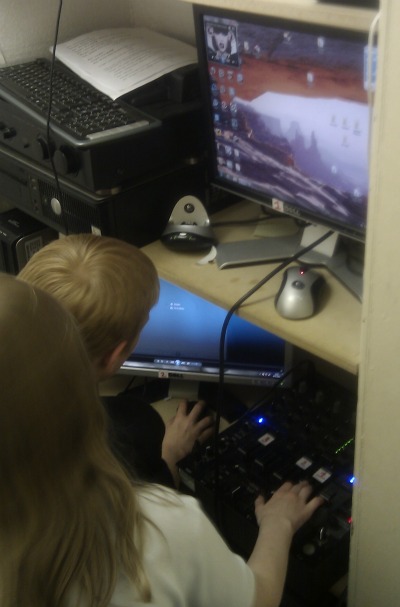 One of the most exciting and rewarding aspects of teaching is being able to bring your own talents and interests to the fore to help drive learning. Chris Mier from Hatton Cruden PS in Aberdeesnhire has done just that this year when he decided to bring the skills and experience he had honed in working in radio and DJing on the internet to the life and learning of his P.7 class. This interest of his was the catalyst for a project that crossed all curricular boundaries and made so many connections across learning. This series of 5 posts will hopefully give you a flavour of this exciting project and yet another illustration of the standards that children can achieve when the bar of aspiration and expectation is raised.
In the teacher’s cupboard in Mr Mier’s room is a cupboard. You know the type - the ones where books, paints, resources etc are kept. However, this cupboard is a little bit different from most. Have a look to see what is inside this one:

This range of resources that includes the cutting edge DJ equipment Tracktor was the resource that enabled Mr Mier to establish a whole class enterprise project based on a radio broadcasting business. 1st Class Kidz Digital radio company became a real enterprise over the course of the second half of last year in this P.7 class. My discussion with Mr Mier about this project can be heard here:
Getting started
 Mr Mier created 25 jobs in 1st Class Kidz Digital that needed to filled. This meant that the perfect opportunity to teach the children about letter writing, CVs, interview techniques within a purposeful and relevant context was established. The children then had to apply for the jobs and were then interviewed for these jobs by some of the parents of the children. Their decisions were then fed back to Mr Mier who posted the newly filled positions on the class Glow site. Once the elation and disappointment of success or other wise had settled it was down to work and to start getting the radio shows produced!
The range of jobs
A radio station needs DJs of course but what else does it require? Well, a station manager was appointed and she was in essence the boss. She held weekly whole class meetings where she was given updates on progress from the DJs, scriptwriters, jingle creators, news reporters, weather reporters, sport reporters, advertising team, art & design team and the class blogger. Each ‘employee’ had to ensure that they were on task and that all necessary work was completed by an agreed due date.
Impact on learning
Mr Mier talked about the success that this enterprising approach to learning had had on his pupils and in particular he talked about his perceptions of:
Having spent an afternoon with the team at 1st Class Kidz Digital I have to say how impressed I was with their industry, creativity and maturity. I think that this shows how Curriculum for Excellence can work so well when a teacher uses specific skills that they have to create purposeful learning experiences for children; experiences that make them want to come to school, to learn, to achieve and to show us just what they can do.
Thank you to all at Hatton Cruden PS and 1st Class Kidz Digital for making me so welcome.
Back in 2003/4 some of my colleagues at the University of Dundee introduced e-portfolio, via Blackboard, to the PGCE(S) course. This was designed to enhance levels of responsibility, ownership and peer collaboration in the course. I was not directly linked to this work as it was led by Bob Doig, Graham Williamson and Joe McLuckie but I watched it develop and grow and became very interested in how this innovative and thoughtful use of technology could enhance learning. In essence the students at Dundee used the GTC’s SITE Benchmarks as the template to which they would document their progress and achievements over the duration of the course. Students would work in peer sets of three and would offer formative feedback on each others work at set times of the academic calendar and whenever else they felt it appropriate. A range of evidence could be drawn upon to show just how the students were meeting each of the benchmarks.
These levels of learner responsibility, ownership and peer collaboration were very much in evidence ‘Doon in the Wee Room‘ in Tarves PS when I saw the children using their iCans; Aberdeenshire Council’s own solution for eportfolio. Quite some way ahead of many others in relation to this the team there had worked with RM to use their Honeycomb service to create a space where children could store their work, share it and reference it to assist in their learning. All this would link with Glow. It made me think about my time back at Dundee but also to think how delightful it was to see this same approach being used with learners of such a young age.
When I was watching the children in Mr Cordiner’s class using a range of technologies I spotted one young learner working with Digital Scrapbook. I asked her what she was doing and she told me that she was making an iCan. What this meant was that she was making her own graphic that would detail something specific that she had been learning about or how to do, and then, in her own words, she’d pop it in to Glow. Watch this video clip to see the exchange between us but when watching look at how natural a part of learning this appears to be for this young girl. It appears that the children in this class and no doubt in others where the iCan is being used are becoming more and more involved in determining the success and challenges they are having or facing in their own progress.
I spotted a display of a selection of iCans that the children had already done and captured some of them. Have a look at what these P.2 children can do.

In view of Building the Curriculum 5 and the introduction of profiles in to P.7 this coming academic year and in to S.3 as of 2012/13 it is very encouraging to see authorities such as Aberdeenshire already make headway in to the area of children developing and maintaining their own learning profiles/eportfolios. As well as the bespoke and robust solution of the Aberdeenshire’s iCan there are other schools and authorities using Glow blogs as a means of profiling too. For Scottish teachers who would like to begin to explore how you could use Glow blogs to help develop profiling/eportfolio in your own context then this Glow group is of great use. (Glow login required)
For those of you who are attending The Scottish Learning Festival 2012 this year then please do bear in mind that there are quite a few teacher led seminars related to eportfolio and how resources such as Glow blogs can assist here.
Finally, may I say thank you to all at Tarves PS for sharing their exciting and very impressive work with me and for making me so very welcome. Good luck with those iCans!
More
 Stop-motion animation used to be something that seemed unattainable to me. I remember many years ago watching movies that my uncle had made that had a number of toy cars and trains moving in a orchestrated fashion. Although I now know that he had been using the technique of stop-motion animation at the time I was in awe of the fact that there were no hands helping to move these toys and props… this was a strange magic! I didn’t realise that this was the same technique that was being used in many children’s TV programmes such as Bagpuss, Trumpton and movies such as King Kong (1933). A few years later stop-motion animation came very much to the fore in my generation’s TV viewing experience when Morph made his appearance on Take Hart. It was amazing to see such entertainment and life come to our screens from a simple ball of plasticene.
When I was ‘Doon in the Wee Room’ recently in Tarves PS I saw this very same entertainment, life AND learning in evidence as some P.2/3 children were making their own stop-motion animation using a basic set that they had made, stop-motion animation software, a digital camera and some plasticene. In my discussion with the class teacher I had learned that this activity had arisen as a result of a discussion with the children about 3D shape. One child had made a sphere out of plasticene but had then cut out a mouth and made the sphere talk. This led to an idea to create an animation all about 3D shape and then their subsequent attempts to bring it to life…

In relation to Curriculum for Excellence it is clear that Technologies TCH 1-04b is being addressed here but the main focus of this learning activity is embedded in Mathematics, namely a focus on 3D Shape MTH1-16a. We can also see from the video how the children are working effectively together to make this project work. Even more importantly in my view is that from this early stage in this classroom these children are being given the framework of opportunities to engage with contexts for learning where they can use digital technologies to create and not just consume. How can such positive attitudes, embedded in their perceptions of themselves as learners, at this stage of their development influence and inform these children’s expectations of themselves, their developing skill-sets and ways in which they can apply these across the range of learning experiences that they will encounter? This can only be good for learners.
The challenge for us all in education is to ensure that we continue to offer such challenging and rich learning environments and experiences where our children can show us just what they can do.
More
In Scotland as in many countries throughout the world, active learning is seen as an appropriate way for children and young people to develop vital skills and knowledge and a positive attitude to learning. In order for active learning to be embedded in environments that offer challenge, demand and appeal we must have teachers and support staff who are well informed and skilled enough in all requisite areas to be able to do this. This series of three blogposts will feature a teacher from Tarves PS in Aberdeenshire who has made great efforts to embed technologies into the life and learning of his classroom so that they can play an active, purposeful and integral part in his pupil’s learning experiences.
Jonathan Cordiner
Having spent 2 years on secondment as a member of the Glow Development team in Aberdeenshire Jonathan Cordiner was keen to return to class so that he could apply, in his own practice, the range of resources and approaches to learning that he had been promoting in his Development Officer role.

On a recent visit to Aberdeenshire it was recommended that I pay a visit to Jonathan’s class to see just how he had been making progress with embedding technologies in to the life and learning of his class. Having worked with him before on some GBL related initiatives I fully expected to see some good practice particularly in view of the high standard and high aspirational levels that he and the team in Glow team in Aberdeenshire attained. On arrival at the school I was welcomed with a wonderfully happy chorus of that great Scottish folk song - Doon in the Wee Room. It set the tone for our visit because it was obvious that everyone is happy, everyone is there, and we’re a’ makin’ merry each in his chair, doon in the wee room underneath the stair.
It was also immediately obvious that the high standards he had been used to in his development role had been maintained and that technology was something that the children in his P2/3 class were more than used to. I saw technology purposefully embedded across a range of contexts that included his pupils:
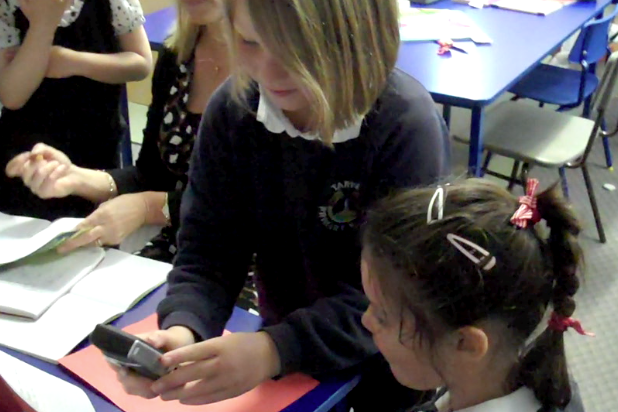 The level of competence and confidence in the use of a range of technologies displayed by the children exemplified just how a thoughtful and skilled teacher can create the active, purposeful and challenging environment that children can thrive in. You can clearly see this as you watch the video that is embedded in this post and as you do please reflect on just how at ease the children are with the technologies that you see them using. How far down the road of developing and attaining CfE outcomes such as TCH 1-03a, TCH 1-04a & TCH 1-04b do you think these children are?
If there had been more time then the aspects of CfE that were linked to the wider learning experiences in which the Technology use was embedded could have been teased out a bit more because it is clear from what I saw that Technologies were seamlessly woven in to the fabric of learning in this classroom.
Mr Cordiner’s class has since moved on to their next challenge with Technologies by making their own computer games with 2DIY. You can view some of these in their class Glow group.
What an experience these pupils are having ‘Doon in the Wee Room‘ at Tarves School. Isn’t this what school should be about? I am very pleased to say that in my experience in visiting schools throughout Scotland that there are very many teachers like Mr Cordiner who are embedding this level of challenge, demand and expectation in all aspects of learning but who are also effectively embedding technologies in and across learning.
Thank you to all at Tarves PS for sharing their great work and for making me so welcome.
MoreAs a result of presentation about the work of LTS’ Consolarium initiative in Strasbourg last year we were kindly invited to present a keynote talk about the place and value of game based learning in Scottish schools at a teacher technology conference in Bergen.
A few weeks back we received a call from a journalist from the Bergen Times whose interest in what was happening with the Consolarium in Scotland was sparked by his reading of the forthcoming conference’s programme. He told us that he had carried out a bit of research and would really like to see this for himself. A date was duly arranged and his flight to Aberdeen from Bergen allowed us to call on out colleagues in Aberdeenshire to showcase the GBL work that is happening in their schools.
 A programme was duly organised and the Norwegian journalist and his photographer spent a day visiting schools who were using a range of computer games in the classroom.
It appears that the game based learning approach that we employ in Scotland is new to Norway and as such it merited a real splash in the Bergen Times Weekend supplement, including a feature on the front cover! It appears that the journalist was somewhat taken aback by the power of what he witnessed in the classrooms he visited and as such he has written a very positive article about GBL in Scotland and what questions Norway can begin to ask itself about how the Consolarium’s ideas, practice and approach might begin to be developed over there.
The article is not online as yet so in the meantime please find attached .pdfs of the article:
Bergen Times Weekend Saturday Supplement main article
Page1: Photograph of kids playing Guitar Hero
There was also a piece following on from the main article that focused on asking schoolchildren from Bergen what they thought about having game based learning in school.
Page 1: Bergen schoolchildren and GBL
Page 2: Bergen schoolchildren and GBL
Finally, there was also a piece in the Sunday edition of the Bergen Times that included comments from prominent Norwegian educationalists about the work of the Consolarium in Scotland.
Bergen Times Sunday edition article
In order for you to make sense of these article we have attempted to use Google Translate so that you can make some sense of the stories featured in the Norwegian press. The translation has worked well although we do think that some meaning has been lost in translation.
There are also some errors in detail in the article that need to be highlighted and corrected:
It appears that the input that we gave at the conference has been well received and has at least started a discussion about the place of game based learning in Norwegian schools. The Bergen Times article has certainly helped!
MoreThe latest edition of the Consolarium podcast is now available. You can subscribe to the podcast from itunes via this link or listen to it via the embedded player.
Super samba inspired learning in schools!
This edition of the Consolarium podcast is solely dedicated to a project that came to an end just before Christmas 2009. Meldrum PS and Slains PS in Aberdeesnhire had been working with the game Samba de Amigo for the Nintendo Wii. When this game first came out the team at the Consolarium thought that this would have great potential in schools and so it was duly purchased. Here’s what it looks like:
OK, I think that after that clip you may be asking, “How on earth can a game that requires the player to shake out samba rhythms help children learn?” Well it most certainly has. What has been going on?
Samba de Amigo inspires ‘relevant and engaging learning’
The methodology that the Consolarium invariably employs in our approach to game based learning involves the computer game being used as the central ‘contextual hub’ about which learning can be situated. We have used this approach with many of our previous projects and it has proved to be a successful methodology. The teachers involved in this project worked together to create a collaborative story that focused on a rags to riches tale about a favela dwelling samba musician who made it to the big time. Accompanying this came the story of a plane, that was carrying the newly created Samba music superstar, crashing in the Amazon jungle and the associated learning about that. Here is some of the children’s work. Here is a news report of that event:
Some people may still be of the opinion that the idea of game based learning is something that does not sit with what school should be about but we would argue that game based learning, if used appropriately, can excite, challenge and create relevant and appealing contexts for learners. Just look at how writing has been developed here”
If you take the time to listen to the podcast about the Samba de Amigo project then you’ll here us talking to a pupil about his experience. If we could have written a script for a pupil to read out about the benefits of game based learning then what he said (without coaching or prompting we may add) would have been what we would have said. He talks about his learning connecting up, about it being exciting and active and how he will rmember this project. Great stuff from him. Here is a brief clip of some boys actively involved in the project and warming up for their Samba music creation lesson.
Hopefully the podcast and this brief blogpost will give you a flavour of just how good this GBL project was. A fuller account of what was done and how this GBL context impacted on learning will be released in the near future. In the meantime can we just say thanks to all at Meldrum PS and Slains PS for working with us on this project.
More
Discover what can be achieved by applying ICT and games based learning to education; explore how you can develop it in your classroom.
Find us on