

Consolarium blog
 A few months back I featured the work of Bernadette Donald from Dundee who was involved in the Land of Me pilot project. She was inspired by the idea that a digital game such as Land of Me was designed to encourage enquiry and learning away from the digital screen, possibly more than actually from it. The context of creating an intrepid explorer mindset, inspired by Eric, Buddy Boo and Willow, in young learners is something that appears to have appealed to many teachers who have been involved with this pilot - including the team at Port Ellen PS.
Outdoor Explorer Logbooks
In order to exploit the children’s heightened levels of curiosity and willingness to explore the outdoor environment and in order to yet again involve parents in the children’s learning the class teacher devised an idea that involved the creation of an outdoor adventurer pack. This pack included:
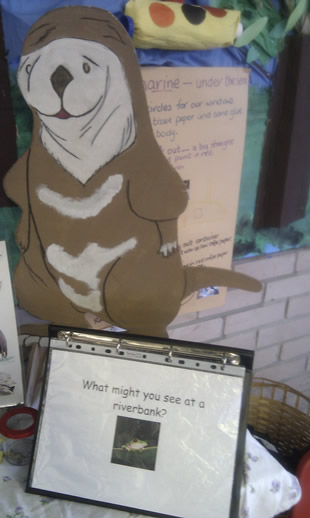
There were four of these packs available to the children to take home so that they could go out into their own environment and explore! The logbooks were packed full of photographs, drawings, stories and information about Islay and the various creatures that can be seen there. One boy even reported seeing an eagle on the roof of the Laphroaig Distillery! A whole host of artefacts were discovered and brought in by the ‘Little Explorers’ and the display table found itself festooned with antlers, shells, broken bird’s egg cases and even an empty wasps’ nest!
As with the earlier post about making outdoor dens in the forest from the school in Dundee the teachers at Port Ellen PS talked glowingly about the impact that this experience and what the overarching context was doing for the children involved. In particular the teachers commented on:
Thank you
Now that we have come to the end of this pilot we would like to take the opportunity to thank the people at Land of Me for supporting our pilot projects and to all the staff, children and parents from Dundee, West Lothian and Argyll & Bute for making so much of what we have done such a positive experience.
More Some months ago we began a pilot project in three local authorities using a resource called The Land of Me. At one of the early meetings in Dundee we met Bernadette Donald from Wallacetown Nursery and she talked about how she planned to use this resource to help support teaching and learning in her setting. Bernadette talked about the opportunities that can arise from the context of this resource, particularly in relation to taking the children outdoors. This aspiration to take learning outdoors resonates very loudly with the aims of Curriculum for Excellence. Part of the rationale that can be found in Curriculum for Excellence through Outdoor Learning states that:
Outdoor learning experiences are often remembered for a lifetime. Integrating learning and outdoor experiences, whether through play in the immediate grounds or adventures further afield, provides relevance and depth to the curriculum in ways that are difficult to achieve indoors…it signposts ways for teachers, educators and their partners to plan for and use the outdoor environment to provide imaginative learning and teaching which is relevant, lively and motivating.1 all staff at every level of involvement with the education of children and young people have a responsibility to make the most of the outdoor environment to support the delivery of the experiences and outcomes of Curriculum for Excellence……Well-constructed and well-planned outdoor learning helps develop the skills of enquiry, critical thinking and reflection necessary for our children and young people to meet the social, economic and environmental challenges of life in the 21st century. Outdoor learning connects children and young people with the natural world, with our built heritage and our culture and society, and encourages lifelong involvement and activity in Scotland’s outdoors.
Taking this rationale on board and considering the needs of her learners Berrnadette planned to take the learning away from the digital screen and to use the context of The Land of Me to allow her and her colleagues to take it out in to the woods (Templeton Woods) so that the children could build a den! She also thought this was a perfect opportunity to introduce this environment to many children who live quite close to it but who have never been to visit this forest on their doorstep. Have a look at this montage of photographs that shows what happened on their visit. Click on the picture to view the slideshow:

Bernadette and I managed to get some time to chat about the Land of Me and to find out why she was interested in taking learning outdoors and just what it was about this resource that enabled this to happen. Have a listen to what Bernadette had to say about this.
As a result of our conversation being interrupted by a youngster in her Royal Wedding dress the interview is in two parts: Here is the end of our discussion!
Bernadette points out a number of issues about this resource and her subsequent pedagogy when planning to use it. These include:
The experience of taking learning outdoors is seen within CfE as one of the fundamental aspects of teaching and learning that will contribute to the development of the whole person. The aspiration to expose learners to an adventurous approach to learning is also at the core of outdoor pedagogy.
It is also argued that the outdoor environment encourages staff and pupils to see each other in a different light, building positive relationships and improving self-awareness and understanding of others. Building dens in the woods is a great place to start!
More*Second guest post from Judi Regan and Dawn Calder at Menzieshill Nursery School, Dundee who are involved with our Kinectimals initiative. Read their first post too.
The children at Menzieshill Nursery School in Dundee are continuing to explore and investigate Kinectimals and extend and develop through games based learning. This blog update, we are focussing on some Health and Well-being experiences and outcomes and these will be highlighted throughout.
Kinectimals offers a fantastic opportunity for physical movement and skill development within an ICT context. A favourite mini game is using a football with the cub, providing ways to manage and control body movements (HWB 0-21a and HWB 0-22a). Children learn to move themselves to the left or to the right, depending on where the ball is kicked back to them, and are frequently left puffing and commenting “I’m sweating!” This allows investigation into raised heart rates – “Put your hand on your chest and feel your heart beating faster” – “why do you think that is?” (HWB 0-28a)
Turn-taking and co-operation skills are enhanced by Kinectimals (HWB 0-23a) and children are independently working out ways to take turns by themselves. We have been using a 5 minute sand timer as a visual aid, however some children are choosing to swap turns depending on the game or toy the cub chooses to bring to play with.
 This style of learning really suits our young digital natives and we have seen many occasions where children are encouraging and sharing tips with their peers. (HWB 0-11a) It’s clear the children love the animated characters in this game, which each group has named. (A challenge in itself, given the noise in the nursery!) The children refer to the cubs by name – “I’m scooting Blacky with the water pistol!” and “I like stroking Spot” giving ownership and different ways to express feelings. (HWB 0-01a)
We made fluffy animal tabards for the children to re-create some of the inside games outside, for example, throwing small balls at targets, and some of the driving games. These have been very popular so much so, we are in the process of making more!
As we have progressed, the staff have become more confident in the start-up sequence and navigating their way around the game.
Now the better weather is with us, as with all nursery schools, the curriculum and just about all the activities move outdoors and we have not been using the game quite as regularly as before, however, as mentioned earlier, the animal costumes have been popular. We intend to use our Beebot (outdoors on a mat) to extend and develop the concept of Kinectimals by dressing up the beebot as one of the cubs and designing a Beebot mat along the lines of some of the games within Kinectimals, for example, when Beebot cub lands on a particular square, the directions may say, “throw the beanbag at the targets” – similar to the gameplay. Our aim is to continue the link with Kinectimals in an outdoor environment.
Check back again later for further updates on our journey into the wonderful world of the Kinectimals!
More*Guest post from Judi Regan and Dawn Calder at Menzieshill Nursery School, Dundee who are involved with our Kinectimals initiative. Judi, along with her HT LOuise REid will be sharing their experience of using Kinectimals at Game to Learn: Take2! on Saturday 19 March 2011.
We’ve been investigating lots of ways that Kinectimals can develop learning in line with Curriculum for Excellence recently. For the purpose of the blog, we will look at one curricular area each update. This fortnight we are focusing on numeracy and in future updates we will discuss some of the other curricular areas. We have included the CfE code in brackets.
Through various aspects of the game the children have been learning to use number for practical purposes such as counting down using the on screen timer. Although the timer starts quite high, sometimes from 60, the children are able to join in the countdown from a number they recognise. Similarly, there are many other games, which develop counting skills such as throwing virtual soft toy piggies at skittles; kicking the ball, turning the skipping rope and many others. (MNU 0-02a)
Cross curricular opportunities for re-creating patterns, such as stripes, spots etc have been explored in our art and craft area. The children have been printing spots and stripes, and have been making masks of the various animals. (MNU 0-03a)
The children have been able to experience positional terminology, such as on top, behind, under, over and are learning left and right by the variety of movements required during the game. While kicking the virtual ball to burst bubbles, the player needs to move from side to side to receive the ball before kicking it back and when they do the assault course there is a great scope to use prepositions such as over, under, by, past, on, through etc. (MTH 0-17a)
Comments and thoughts from children and staff have been very positive since beginning this project. The children are saying every day, that they want to play Kinectimals and there is always a queue. Sharing and turn-taking skills are clearly being demonstrated here! When asked “What do you like best when you play Kinectimals?” responses included, “I like when you throw the ball” and from another, “I like it when you jump up and down”,(teaching the cub new tricks, such as jumping, star jumps, etc) and “I like it when you throw the piggies at the thingys!” (it’s dominos and skittles being referred to!) There has been lots of discussion around the water pistol activities and the children empathising (or not) with the cub who’s fur gets soaked! Admittedly, some of the games have required a degree of skill and it depends on which child and which adult is there as to who helps who!
Staff opinions have been positive also, despite some feeling slightly apprehensive about using the console, although after a short time, their confidence grows. The whole idea of using your hand/body to control the game has been a learning curve for everyone, and staff and children alike have been pleasantly surprised at how easy it is to get the hang of.
Parents and students have been quite incredulous that a nursery school is using a games console for learning opportunities, and a number have shared personal experience of using one at home. To this end, we are considering holding a Gaming evening in the future, for parent’s to come and have a go – and to share some of the educational benefits of games based learning.
MoreIn March 2010 representatives of LTS’ Consolarium team attended and participated in the Game Based Learning Conference in London. One of the conference presentations that we saw was from a company called Made in Me who were showcasing their as yet unreleased resource, Land of Me. The team found this resource to be instantly intriguing and it’s design, both aesthetic and pedagogic, was such that we approached the company to express and interest in trying the software out in Early Years settings in Scottish schools. Have a look at one of the chapters here:
One of the aspects of this resource that proved most appealing to us was that the designers had worked with Prof. John Siraj-Blatchford who has a long and illustrious record in academic publication and is seen, along with his wife Professor Iram Siraj-Batchford, as expert in the pedagogy of teaching and learning in the Early Years. The partnership between Dr. Blatchford and Land of Me led to a the design of a resource that aimed to immerse young learners in a beautiful and engaging world but in such a way that opportunities for deep learning and active participation could occur within the game but just as importantly, away from the game. This concept is what most interested us about this particular resource as we felt that it most certainly would help address the underlying principles of CfE and offer exciting and purposeful avenues for learning at Early Level and possibly beyond that.
The LTS/Land of Me Pilot
 Once the Land of Me was fully completed and ready to be launched to schools LTS negotiated a pilot programme to take place in Dundee City, Argyll & Bute and West Lothian Councils. This pilot is currently in its early stages with schools in Dundee and West Lothian already making great use of the resource with the Argyll & Bute schools due to come on board at the end of March.
As yet we have no firm data in terms of qualitative feedback from out partner schools other than a general feeling of delight and positivity in relation to how young learners are responding to this resource and the learning activities that can arise as a result of playing in and outwith the game.
This was evident in a recent feedback session in Dundee City from the teachers and Early Years Practitioners who working with us on the pilot. Their early feedback was very positive with some insightful observations about its use being fed back. Most of the feedback that was of the ‘wish’ variety focused on the activities that could be downloaded from the resource itself. Even so, the general feeling was that this resource has great potential with Chapter 4: Rythmn & Dance, where the learners/players have the opportunity to dance along with a family of Otters, appearing to be a particular favourite for the children in the Dundee schools! Can you do the crab, flamingo, tiger dance?
I took the opportunity at the event to speak to Maggie Llanwarne who is the Headteacher at Longhaugh Nursery School about her thoughts on the resource. Maggie was very impressed with the resource however her experienced eye also offered some formative fedback in terms of its design and how it can be used. Here is what Maggie had to say:
I also spoke with Bernadette Donald from Wallacetown Nursery School. Again her feedback was very positive but some formative ‘wishes’ were also suggested by this experienced practitioner in terms of the tasks/activities that can be downloaded as a part of the overall Land of Me experience: Here is what Bernadette had to say:
Some of the schools talked of how they were still exploring the resource whereas others talked of how having explored the resource, they were now beginning to embed Land of Me in to the daily life and learning of their children. We look forward to sharing the further experiences and thoughts of teachers and EYPs in Dundee and those of the teachers and EYPs in West Lothian and Argyll & Bute. If you are using this resource in your school please do tell us what your experience has been.
*There is a Land of Me Glow Group to support this initiative and any other teachers who might be using this resource in their particular setting. Please do feel free to contribute to this group.
More Quite a lot of big projects going on at the moment, so a lot to juggle and loads of very interesting, positive findings coming out of the work being undertaken. Our MangaHigh pilot will be coming to end within the next few weeks. We will then have some data to examine and measure the impact of it’s use across a number of secondary schools in Glasgow and Edinburgh. Should be really interesting. Great to see Cleveden, Lochend, Knightswood and Jordanhill in the top ten scorers for this round and well done to Jordanhill, Lourdes and Cleveden who are also in the all time top ten league.
I am heading back up to Highland to visit schools in Castletown, Dornoch and Alvie who along with Dingwall Primary have been undertaking GBL topics using a range of games as part of the Highland Literacy Project. Initial reports are very positive and I am very much looking forward to getting reacquainted with the children and schools over the next week or two. Hear some of the initial thoughts from Dingwall and Alvie below
This week will also see me delivering to a range of Dundee City teachers at a CPD event run by Louise Henderson and the team from Dundee City (check the Glow Group for links to the work they have been undertaking) and then Brian Clark and Myself are heading to Dundee University to show a range of students the kinds of experiences GBL can offer.
As an aside I have also undertaken my Glow mentor training so hopefully the Consolarium Glow Group will continue to improve. Why don’t you check it out and get yourself involved in some of the conversations or start one of your own.
More The Consolarium’s attempts to bring games based learning to the Scottish Learning Festival culminated in the final of the Sonic and Mario at the Olympics competition at the Gamezone Challenge. The past month has seen Scottish schoolchildren attempting to qualify for the finals by playing the trampolining game and their expertise left me with a little bit of egg on my face… I had thought long and hard about which game to set as the qualifier and after much deliberation I chose the trampolining because I thought it was far too difficult to get a perfect 10 and that the children’s efforts would be a real spread of scores that would allow me to get my 8 qualifiers for the final. Great thinking on my part because on the final day of qualifying no less than 19 children had registered a perfect 10 on the leaderboard! As a result of this four of the qualifying schools had their own play-offs to select the two children who would represent their school at SLF ’08.
 The event itself was brilliant. Children from Lairdsland PS & Woodhill PS (East Dunbartonshire), Clepington PS (Dundee City) and Cathkin HS (South Lanarkshire) came to compete and compete they did. A large crowd had gathered to see the competition and they gave superb backing to all the competitors with Simon Tait from Cathkin HS just taking the title in the last game. Simon won an Xbox 360 with Guitar Hero plus a Nintendo Wii with Mario Kart and a Wii Fit for his school.
The Gamezone Challenge proved to be a real hit and hopefully it will become a fixture of the Scottish Learning Festival in years to come. Well done to all who participated.
MoreRecently it was announced that LTS’ very own Laurie O’Donnell was given the great honour of being named as one of the Global Six by the George Lucas Foundation. Laurie was recognised for his work in leading developments with technology in Scottish Education. The people at the Foundation were particularly take with the vision that was and has become Glow. Congratulations to Laurie for this, such recognition helps to affirm that you are most certainly on the right lines!
Through Laurie’s links with Edutopia we had the pleasure of welcoming Milton Chen and Steve Arnold to Scotland last week. This was so that these gentleman could find out a little bit more about the work that LTS is doing in helping to lead developments with technology in Scottish schools. Andrew Brown from LTS took care of the programme for the Thursday and I had to organise the Friday programme.
 After meeting Milton and Steve at the train station I was given time to share with them the work that we have been doing at the Consolarium. They were really taken with what I told them about and were particularly interested in our Dr Kawashima, Guitar Hero and Nintendog projects. In order to try and bring what we do to life for them we organised a visit to Clepington PS in Dundee to see a P.6 class who have been using Sonic and Mario at the Olympics for the Wii as the contextual hub for a cross-curricular project.
The children had recently held an open afternoon for parents so that they could show them the work that they had been doing with the game. I asked the children what their parents had thought of this idea of using a Wii in class and they said:
“…my mum and dad thought it was nonsense and that we were just playing games. That was until they saw what we had been doing and they couldn’t believe it. They were really impressed.”
“…parents think that games rot your brain but they don’t, they help you think and get smarter. My parents thought the project was magnificent…even great!”
“…my mum was dead surprised that I was doing all this writing. I don’t normally like writing but I didn’t mind it in this project.”
Milton and Steve spent time talking to the children at all the learning stations that were set up and they were impressed with the level of motivation and enthusiasm that was clearly in evidence but also impressed with the confident and articulate way they engaged with their American visitors.
A quick visit to Charleston PS to see one of the classes involved with the extended DS project was planned for the afternoon. A warn welcome was given by Chris Smith, Depute Head, and the P.6 class. We asked the children how they were all getting on with the DS and then watched them take their Brain Age check. It looks as though they are getting to grips with the game and making progress already!
Thanks to both schools who made themselves available to us that day and for giving such a warm welcome to our visitors. I know they had a very enjoyable and interesting day.
MoreThe past two weeks have been rather hectic, with the promise of more of the same next week. I’m writing this post from the Western Isles EDC offices in Stornoway having completed another leg of the LTS extended Dr Kawashima project.
Last year we carried out a small-scale intervention using Nintendo DS & Dr Kawashima in a P.5/6 class in Dundee. Thew results proved to be so interesting that we managed to access funds that has allowed us to extend this to 16 schoolsd with Nintendo with 16 control groups. The methodology is very similar to what we did last year with the exception that we only have Nintendo groups and control groups this time around and the fact we are using different measures to the Burnett Self-Scale that we used last year. So now things are well under way…
We had a great start last week in Aberdeenshire schools that are taking part. It was an experience, to say the least, to have some headteachers waiting at the front door for my arrival and then to be welcomed with the excited exclamation, “It’s the Nintedno man!” The pre and post tests went like clockwork, no small thanks to Anna Rossvoll, Alison Butcher and Caroline Denning from the ‘Shire’s ICT team as well as Elizabeth Cole from HMIe. What a team!
This week has seen me carrying out the needful in the Western Isles with my colleague from the University of Dundee, Dr David Miller doing likewise in the participating Dundee schools. Next week will see us both doing the same in our partner schools in East-Ayrshire.
I’ve always said that teaching is a great career but it’s an added bonus to see the gleeful reactions and to hear the gasps of disbelief when we tell ther children that they are getting to use the DS in class, and that we are giving them one each for the 10 week duration of the project. Good times.
We’ll all be back to visit the schools to carry out the post-tests in 10 weeks time and then for the analysis…
MoreLast week I took the Consolarium to a CPD event in Dundee. I was invited along by the ICT Staff Tutor team in Dundee to contribute to an in-service day that was to take place in a city centre hotel. The idea was that it would act as a mini-exhibition similar to the one that LTS has at The Scottish Learning Festival. Organisations and companies whose business is focused on ICT in teaching and learning were invited along to raise awareness about how their products could impact on teaching and learning.
The staff tutors were also working in conjunction with the Learning Together in Dundee (LTiD) team. LTiD is Dundee City Council’s main driver in relation to embedding formative assessment strategies in classroom practice and this was designed to highlight ways in which ICT and LTiD could work in tandem. Have a look at how one school in the city is implementing this strategy.
The Consolarium stand was given a prime spot with a ridiculously large projection screen, however, it made the games look even more spectacular. I had taken along the Xbox 360, the Wii and the PS2 as well as Nintendo DS and Sony PSP machines. I also took along a variety of games that would exemplify a wide range of curricular applications of games based learning.
To say the stand was busy is an understatement. The teachers who came along (and it was estimated that almost 900 were in attendance over the course of the day) were very interested in what games based learning was all about and how it might work in their clasrooms. Many of them had read about our Dr Kawashima project and quite a few had visited the Consolarium’s website. Many of the Wii games proved a hit but Guitar Hero was the most popular of the day. At one point there was chorus of ‘Sweet Child of Mine’ drowning out almost everything else as a large group of teachers let their hair down and lost themselves in the game when two of their colleagues battled out that song. Apologies to the other presenters who were beside me.
I have made a short podcast of the day which can be accessed via my own blog for the time being.
Hopefully this will give a flavour of the day and of how the teachers enjoyed this ‘different’ approach to in-service.
Thanks to all at Dundee for the opportunity to share our work with their teachers and thanks to the teachers who engaged, in such an open-minded and enthusiastic fashion, with the resources and concepts underpinning our work .
More
Discover what can be achieved by applying ICT and games based learning to education; explore how you can develop it in your classroom.
Find us on