

Consolarium blog
When I first chatted with Janice McRae about her plans for using The Land of Me one of the first things she made reference to was her desire to encourage parental involvement in the project. Having a strong belief that parents should be as good a partner as possible in helping children learn she was very keen to create ways in which this could happen. A letter of information was sent out to all parents asking for help with building some of the class scenes as well as telling them about the opportunity to come and in to the classroom to support some learning activities.. This desire is very much in concert with that of Scottish Government’s views on parental involvement:
Parents who take on a supportive role in their child’s learning make a difference in improving achievement and behaviour. The active involvement of parents in the life of the school can help promote a learning community in which pupils can engage positively with school staff and their peers.
I was keen to get an overview from some parents about what their perception of this project had been and what impact, if any, they felt that it had had on their children. One mother I spoke to talked of her delight at being asked in to the classroom to help in the first place but also of her sense of amazement at the spread and range of
 curricular activity that was happening. She also commented on the information letter that went home from the school being something that immediately captivated her attention and at her delight of how the project helped make relevant learning about her daughters own community and environment.
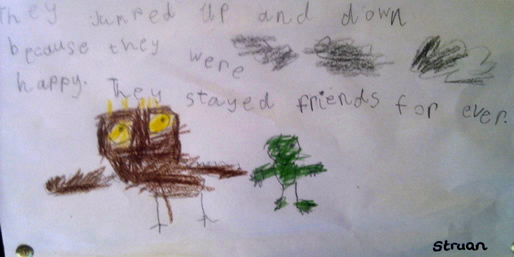
On the day that I visited the class a writing activity had been planned that involved parents coming in to help the children with a story about the characters in The Land of Me. There were quite a number of parents in the room that day and the atmosphere was focused and industrious. Following on from the stories that can be read when the player/learner visits Granny Olive in The Land of Me the guidance given to the children and the teacher was
 that their story would be in three parts, would contain one of the main characters from The Land of Me and that it would have either a happy, sad or funny ending. The parents acted as scribes where appropriate and worked with their child to encourage the telling, drawing and writing of their own Land of Me story.
I also took time to interview some of the parents that took part in this writing session. The parents were hugely impressed with the open and visual nature of the learning environment and they were delighted to be playing such an active part in their children’s learning in school as well as out of school.
Parent Interview 1
Some of the points of made by this parent about this experience included:
“This approach to learning is completely different, it really leaves it open to their imagination.”
“The reading, the writing and the arithmetic is all in here..the kids are making it all themselves.”
“It’s been great getting in here and seeing them working…the classroom is so vibrant and busy!”
Parent Interview 2
Some of the points of made by this parent about this experience included:
“This is fantastic, lovely…I like that we’re involved in it all.”
“It’s fantastic because they can get so involved in it. It’s not like just picking up a book and putting it away-they are part of it every day.”
“My husband and I coming to help has been significant for us…we know what she is talking about when she comes home because we have been involved.”
Port Ellen PS clearly view the parents of their children as a valuable resource and as allies in helping to take children forward. It was clear from my discussions with the parents that such willing encouragement for them to be part of the life of learning really made them feel god about being a partner in their child’s development. What I saw in my time there is testament to this approach-happy children and happy parents working together with thoughtful and committed teachers in a vibrant and inquisitive learning space.
MoreOn 20th November 1985, Microsoft released Windows 1.0.
This year is the 25th anniversary of Windows 1.0. In the 25 years that have followed, Operating Systems have evolved. A lot. Windows 7 mobile, Mac OS X, iOS, Android and Linux are all commonly used Operating Systems today. And there are many more!
To celebrate this event, we are running a competition for you to create an InfoGraphic about operating systems. The winning InfoGraphic will turned into a poster and sent to all schools who take part.

Competition Details
Can you create an Infographic to chart the development of Operating Systems over the last 25 years? Here are some ideas….
Hold on, what’s an InfoGraphic?
An InfoGraphic is representations of information, data or knowledge. These graphics are used where complex information needs to be explained quickly and clearly. Information is conveyed by graphic elements, including charts, graphs, text, dates and images.
Some examples of infographics are shown here …


Reasons To Get Involved
Important Information!
Closing Date has been extended to 17th January 2011
More

At the Consolarium, we are always eager to look for new games to add to our Game Based Learning projects. In mid November 2010, Electronic Arts will release EA Create.
Create Game Info
In Create, use your creativity and imagination to unlock a world of play!
Create tracks your creativity and rewards you for it. The more you create, the more you unlock rewards and exciting challenges to play, opening a world of fun as you go.
Let your imagination run wild, as you create cool environments with easy-to-use tools, including animating objects, textures, and designs that bring your scene to life!
It’s a limitless experience of creative expression paired with exciting and even wacky challenges that have you thinking on your feet to come up with creative solutions.
EA Create seems to have more than a couple of similarities to Little Big Planet for the PS3, but with one big difference - Create will be available for Wii, Xbox, PS3, Mac and PC. With an internet connection, users on any platform will be able to upload their creations and download any other creation and remix it - regardless of what platform they are using, with the exception of the Wii.
This particular game seems to offer a number of opportunities for Game Based Learning projects and indeed may be a great tool to close the gap between game players, game based learners and game creators. A few reasons we are hopeful for this particular game include:
I was thinking that schools could use this game to engage with probelm solving and creativity. Then, set groups of pupils a challange to build a crazy contrapation like a Rube Goldberg machine, just like they can do in create - solve a simple problem by creating a complex solution. Have a look at OK Go’s video for their song ‘This To Shall Pass’ to see such a machine in operation.
A project like this could be a great way to build teamwork, cooperation, environment/recycling, not to mention inter disciplinary links. Look out for an update in the new year once we’ve had a chance to get creating ourselves!
MoreThe latest edition of the Consolarium podcast is now available. You can subscribe to the podcast from itunes via this link or listen to it via the embedded player.
Super samba inspired learning in schools!
This edition of the Consolarium podcast is solely dedicated to a project that came to an end just before Christmas 2009. Meldrum PS and Slains PS in Aberdeesnhire had been working with the game Samba de Amigo for the Nintendo Wii. When this game first came out the team at the Consolarium thought that this would have great potential in schools and so it was duly purchased. Here’s what it looks like:
OK, I think that after that clip you may be asking, “How on earth can a game that requires the player to shake out samba rhythms help children learn?” Well it most certainly has. What has been going on?
Samba de Amigo inspires ‘relevant and engaging learning’
The methodology that the Consolarium invariably employs in our approach to game based learning involves the computer game being used as the central ‘contextual hub’ about which learning can be situated. We have used this approach with many of our previous projects and it has proved to be a successful methodology. The teachers involved in this project worked together to create a collaborative story that focused on a rags to riches tale about a favela dwelling samba musician who made it to the big time. Accompanying this came the story of a plane, that was carrying the newly created Samba music superstar, crashing in the Amazon jungle and the associated learning about that. Here is some of the children’s work. Here is a news report of that event:
Some people may still be of the opinion that the idea of game based learning is something that does not sit with what school should be about but we would argue that game based learning, if used appropriately, can excite, challenge and create relevant and appealing contexts for learners. Just look at how writing has been developed here”
If you take the time to listen to the podcast about the Samba de Amigo project then you’ll here us talking to a pupil about his experience. If we could have written a script for a pupil to read out about the benefits of game based learning then what he said (without coaching or prompting we may add) would have been what we would have said. He talks about his learning connecting up, about it being exciting and active and how he will rmember this project. Great stuff from him. Here is a brief clip of some boys actively involved in the project and warming up for their Samba music creation lesson.
Hopefully the podcast and this brief blogpost will give you a flavour of just how good this GBL project was. A fuller account of what was done and how this GBL context impacted on learning will be released in the near future. In the meantime can we just say thanks to all at Meldrum PS and Slains PS for working with us on this project.
MoreOver the last wee while I have been visiting schools to see the impact of some ongoing projects. I visited Tullos Primary in Aberdeen where a class of primary 6 children have been undertaking a Wild Earth African Safari. I popped in to see a primary 3 class in Dingwall Primary working on a Nintendogs project and then off to Alvie Primary in Kincraig near Aviemore where a composite p 3/4/5 were taking on their own African Safari.
In Tullos Primary the teacher undertaking the project spoke about her experience at an InService day and the rest of the staff were so impressed by the potential that they will be purchasing gaming technology of the ir own so games based learning can be extended throughout the school.
In Dingwall primary the children have been using their Nintendogs to enhance and improve literacy. Both management and class teacher have been amazed by the impact and how the desire to write and reach an audience outside the school, through their blog, has moved the learning of all the class forward.
From Alvie Primary the teacher has tied the whole experience together as an enterprise Activity and will showcase the work for parents in a Safari afternoon. She also reckons that when the wii is returned to the Consolarium it will have a whole class of children attached to it who will not let it go!
In all classes I was met with enthusiasm and engagement and a joy about learning. In the Guardian newspaper last week Professor Stephen Heppell comments that ,
“Play is something that ICT has been bringing into learning from the very beginning. ICT in learning holds the potential to bring back playfulness and engagement…”
The Games based learning approach taps straight into this potential and, for those of us working in the Consolarium, we are lucky enough to see practical examples of the impact of this everywhere we go. Share the joy! If you and your class or school are using games based learning then please let us know and share your good practice.
MoreJohn Donne espoused that we are all connected and I think that we are all the better for it. Having connections whether familial, social or professional enriches all that we do and extends, supports and challenges us.
I have been thinking recently about the way my learning has changed now that I am no longer in a school setting and how much I relied on the people in my school staff to bounce ideas off, to rant to, to use the experience of and to laugh with. Now that I no longer have a physical staffroom to use I have found myself using the skills and knowledge of a different set of people in a very different way. I have a virtual staffroom, open 24hrs a day containing a set of people from all over the world, with a huge array of skills and experience which I can tap into, and who generously share their learning. I use Twitter. There, I’ve said it and it doesn’t make me a bad person!
One of the first people I was in contact with in my very early days of twitter was Caroline Breyley, the headteacher of Burravoe Primary School on the Island of Yell, the second largest of the Shetland Isles.
She and her class were considering the use of Wild Earth: African Safari for the Wii and wondered if it would be a worthwhile context for learning. Through the work they have shared with me it is clear that they have been involved in a very engaging, motivating and successful piece of learning. I had the great privilege of meeting the children online at the tail end of last week. We set up a Glowmeet and through the use of this technology children over 400 miles away, including at least one flight and a ferry, could share the fantastic work they had done with me in real time and get immediate feedback. Go and visit the Burravoe Primary School blog, read about life in their school and read the “Brilliant Story” by Charlotte in p3.
Through the use of technology available to those in Scottish Education our children have access to an immediate national audience for their work, Glow groups, glow meet, CANVAS and a host of blogs allow our children the opportunity to share their work and receive feedback . We should all be sharing our practice and seeking feedback on the work we do and providing constructive feedback on the work of others. We cannot afford to be islands.
More
A new case study has just been published on the LTS Consolarium site. Looking at the use of the Myst game in schools in Aberdeenshire in Scotland it documents how the project began, how Tim Rylands helped with CPD and the impact on learning it has had in one school in particular. Have a look to see how paired writing tasks were initiated and how it has motivated reluctant writers to write
We’d love to hear from anyone else who is using this game so that they can tell us what their experience was.
MoreApologies to all at Stirling Council for the lateness of this post regarding your presentation at SLF ’07 but I have been waiting to see if I could source some photographs of your session. As yet I haven’t but I’m still looking!
One of the very early adopters of games based initiatives with the Consolarium was Stirling Council. The team came to visit the centre in early 2007 and as a result of the day we had a number of possible projects were discussed. One particular application caught the eye of the team that day and they felt that it had the capacity to really engage reluctant writers so that they would want to write. The application in question is called Crazy Talk and it really has great potential as a learning tool. Their presentation was yet again bursting with life, character and good practice. Margaret Cassidy and Joe Shaw from the Quality Development Team gave the presentation with help of some children from a local school that had been using the software.
The children talked about how they had used Crazy Talk in different topics of study. One such topic was a collaborative investigation of the story and history of the ill-fated Titanic. The kids created their own drawings of people that were on the Titanic and then they brought them to life in Crazy Talk. Have a look at one of these characters created by the kids:
A fiull case study of what has happened with this application and how it has impacted on the teaching and learning will appear on the Consolarium’s sharing practice very soon.
In the meantime have a look at how you use Crazy Talk:
A number of other local authorities are using this application so we look forward to finding out more about how it is making an impact in those schools too.
More
Discover what can be achieved by applying ICT and games based learning to education; explore how you can develop it in your classroom.
Find us on