

Consolarium blog
 So, it’s the end of the school year and Modern Foreign Language pupils at Firrhill High School in Edinburgh have been reflecting on the use of My French Coach on the Nintendo DS in their French lessons. One of the pupils, wrote about her and her classmates experience of the DS in the school magazine, Firrhill Heights.
You can read her article here.
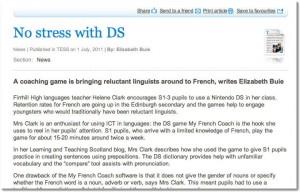 Helene Clark, the languages teacher who lead the project is delighted with the impact the game has had on her pupils learning and spoke to Elizabeth Buie at the TES about her experience. You can read the article here.
As a result of the project, Helene submitted a proposal for funding from the PTA at the school in order to buy language based DS games, and other games the Consolarium have used in the past, to be kept in the school library for pupils to borrow in order to improve their French, or indeed get a taster of a new language. Helene stated:
I managed to purchase 14 games for our school library, as well as 2 DS consoles. The idea is that children will be able to borrow the games as they can borrow books to practice French, German, Spanish and Mandarin at their leisure. I have also purchased a couple of “My Word coach” and “Brain Training” games to show that some games can be used to support literacy and numeracy.
The My French Coach games for the DS have been discontinued, however, Ubisoft have made the game (and others) available on the iPod touch / iPad at a cost of £2.99 from the AppStore, thus making it even more accessible to pupils / departments who have these devices.
MoreAt the beginning of 2010 the Consolarium team, in their attempts to sow the seeds of innovative practice in schools, announced a competition that was to be held at that year’s Scottish Learning Festival. Based around the game Mario Kart for the Nintendo Wii the challenge was to se how fast you pupils could complete a lap of one the Mario Kart tracks. Teacher verified times were then emailed to us to be added to our Scottish Schools Mario Kart leaderboard. We must have loaned out over 20 sets of Mario Karts to schools across Scotland with the expectation that the game play would lead to a range of ways in which curricular activity could grow from the contextual hub ofd this game.
Sometimes when you plant seeds unexpectedly beautiful things can grow…
I was contacted by Wilma Leaburn, a QIO from Renfrewshire, a few months back and invited to a Mario Kart CPD evening at a school in Paisley. Apparently a number of teachers had taken this practice forward and a CPD session to share their experiences had been organised and so oversubscribed that another two evenings were to be delivered. The evening itself was a fantastic example of how creative teachers can be and how, when give the chance, their own idiosyncrasies can lead to wonderful learning experiences that meet the needs of their learners. At this event I met a teacher called Julie Paterson who invited me to Mario Kart open afternoon for parents and carers at her school, Bargarran PS in Erskine. This series of posts will feature my observations at this event.
What’s in the box? Creating the context
The children I met at Bargarran PS were just superb. They welcomed me into their class and were so eager to share with me what had been happening and what they had been learning about. In the middle of our earlier conversations it became clear that the arrival of the Wii into their class had been a bit special. Apparently, a gold box arrived one day and the question being asked was ; What’s inside the box? Lets let the children carry on the story…
The writing activity that arose from this early context creation was featured on the wall. Have a look at some of the children’s writing:
The Teachers’ Perspective
Julie Paterson and Jill Day were the P.2 and P.3 teachers that led this project. I took the opportunity to interview them after the Mario Kart open afternoon had ended.
Some of the strong messages about their observations and experiences with the Mario Kart project are:
“The parents have been incredibly supportive.”
“Sharing information and plans with the parents at the beginning of the project helped build that trust with parents.”
“The initial attention-grabbing context creation captured the children’s imagination and interest.”
‘Some children, who maybe don’t engage as well as the teachers would like in class, showed increased levels of motivation and willingness to engage with learning.”
“The Mario Kart project had a particularly positive impact on boys attitudes to learning.”
“Fun, personalisation and choice should be at the heart of learning experiences within contexts for learning in Curriculum for Excellence.”
Thank you to the teachers, the pupils and parents at Bargarran PS for making us so welcome and for sharing the life of learning with in their classrooms with us,
MoreRead Part 1 here
In S3, pupils have a fairly developed knowledge of French and my class has initially enjoyed playing the game and progressing through levels for the first couple of weeks of its used.
They soon needed to be more challenged and felt that the “compare” tool (repeating phrases) was making them feel self aware in front of others in the class.

Pupils were asked to work in pairs in order to create a conversation in French using the My French Coach software. They were invited to choose a topic of their choice and make reference to their consolidated knowledge of French in order to create sentences which were grammatically and structurally correct. Their task was flexible in terms of length, vocabulary, originality, use of humour and props, etc…
Previously, pupils had only practised very short, set up role plays in class on specific topics.
Pupils first familiarised themselves with the phrase book and dictionary tools. Each pair then discussed and agreed on a topic and started constructing their sentences being able to get confident with unknown vocabulary using the “compare tool” in order to learn and practice the pronunciation of their new words.
The phrase book tool offers a variety of topics (such as holidays, greetings, shopping…), most of which haven’t been taught in class.
Below, we can see a short clip of pupils discussing their role play using the DS.
Once the task was completed, pupils were filmed, performing their role play and were asked to assess each other as follows
Pupil A: “It’d be good if the phrase book focussed more on topics studied in French such as school, but the compare tool helps with pronunciation.”
Pupil B: “I enjoyed using the DS and feel it’d be good if there was a voice recognition device where you can record your Standard Grade speaking pieces and it would then be said by a French person!”
I feel this task has been very well received by my pupils. They felt it was something exciting to do and it really raised their confidence in speaking French as well as thinking about their next steps in order to make progress.
During the preparation of their task, pupils needed teacher’s help but a lot less than for other types of writing work. I also felt that pupils were “on task” and developed their social skills without realising: compromising, working as part of a team, listening to others’ views, use of praise and being considerate: “is it ok to use stereotype? Will I offend someone?”
Below is an example of the role plays produced by the pupils.
Finally, we can see the critera chosen, and the feedback given by the pupils.
Read Part 1 here
More Unity 3 is a cross platform development environment (PC or Mac) which provides users with a set of tools to create games for PC, Mac, Wii, iOS devices (such as iPodTouch, iPhone and iPad) and Google’s Android Mobile operating system. It’s a jack of all trades system and the core software is free for all to download and use. This video shows just a few of the games that have already been created with Unity.
We’ve been spending some time at the Consolarium looking at Unity 3 and we’ve been very impressed with what is possible with the software. The level of support available online from the Unity site and from the developer community (including the great game tutorial videos at 3DBuzz) is excellent and this wealth of quality resources can really support learners as they take their first steps with this software.
Our plans to support game design in the senior phase require quality tools which provide learners with opportunities to produce games similar to the ones they play. Also, game design in the senior phase must build on the CfE experiences and outcomes and our work on game design at level 2/3 with Scratch and Kodu. Given the recent developments in game design qualifications, it is important that we look for and develop resources which support learners undertaking these new courses. Unity provides a versatile platform which can help us achieve all of these things.
With practicalities in mind, Unity will run on a variety of computer systems including those which are getting a bit old. It requires Windows XP Service Pack 2 OR Mac OS “Leopard” 10.5 as a minimum spec and a graphics card with a minimum of 64MBs (which should cover any graphics card made in the last 6/7 years). Other demands on your computer system just depend on how complex your game project becomes.
One of the really great features that we hope to make use of is Unity 3′s ability to create browser based games which play from the web. Have a look at blurst.com to see some of the great web based games created with Unity. Jetpack Brontosaurus is my personal favourite.
Moving forward our plan is to make the best of these resources available in the Consolarium Game Design Glow Group and to develop further resources and support for schools which adopt Unity as a development platform. Already in our Glow group are resources for Scratch, Kodu, Blender and Microsoft XNA Game Development. There are also a number of background resources which deal with the game development process and were filmed at the Denki Studio in Dundee.
More<cue Murray Walker voice>
………….and there goes Mario!
………………and there goes Luigi!
F1 season is well underway and all over Scotland schools are taking up the SLF10 Mario Challenge.
Would you like to race head to head, in front of a live audience and win the title of
SLF10 MarioKarter Champion ?
This year at SLF10 there will be a Mario Kart Grand Prix for Primary and Secondary pupils. In order to qualify you must be in the top 4 verified time trial times.
Teachers must submit a photo of a pupil’s verified Time Trial time. These times will be logged on a leader board held on the Consolarium Glow Group and blog so you can track your position against the whole of Scotland.
At the moment these leaderboards are empty (apart from my rubbish time!) - submit your time now!
The four fastest primary pupils and four fastest secondary pupils will be invited, with school representatives, to compete in a live race final at SLF10. In order to submit a qualifying time you must run your time trial according to the criteria below.
| The character must be | MARIO |
| The circuit must be | MARIO CIRCUIT |
| The Kart must be | STANDARD KART |
A picture of the complete time trial showing character, kart and time should be forwarded to[email protected]
The four fastest pupils from each sector will then race head to head in the
50cc Mushroom Cup Grand Prix
in front of a live audience at SLF10.
The driver with the most amount of points at the end of the Grand Prix will be the winner and crowned Mario Kart Champion SLF10 and win a Wii and copy of Mario Kart for their school.
Check out the glow group where schools involved will be posting plans, pictures and joining discussions about the game and the work they are undertaking within their class using Mario Kart as a contextual hub or as a subject specific theme.
The closing date for verified Time Trial times is September 3rd 2010. Qualifiers will be contacted after this date
More
The latest edition of the Consolarium podcast is now available. You can subscribe to the podcast from itunes via this link or listen to it via the embedded player.
Super samba inspired learning in schools!
This edition of the Consolarium podcast is solely dedicated to a project that came to an end just before Christmas 2009. Meldrum PS and Slains PS in Aberdeesnhire had been working with the game Samba de Amigo for the Nintendo Wii. When this game first came out the team at the Consolarium thought that this would have great potential in schools and so it was duly purchased. Here’s what it looks like:
OK, I think that after that clip you may be asking, “How on earth can a game that requires the player to shake out samba rhythms help children learn?” Well it most certainly has. What has been going on?
Samba de Amigo inspires ‘relevant and engaging learning’
The methodology that the Consolarium invariably employs in our approach to game based learning involves the computer game being used as the central ‘contextual hub’ about which learning can be situated. We have used this approach with many of our previous projects and it has proved to be a successful methodology. The teachers involved in this project worked together to create a collaborative story that focused on a rags to riches tale about a favela dwelling samba musician who made it to the big time. Accompanying this came the story of a plane, that was carrying the newly created Samba music superstar, crashing in the Amazon jungle and the associated learning about that. Here is some of the children’s work. Here is a news report of that event:
Some people may still be of the opinion that the idea of game based learning is something that does not sit with what school should be about but we would argue that game based learning, if used appropriately, can excite, challenge and create relevant and appealing contexts for learners. Just look at how writing has been developed here”
If you take the time to listen to the podcast about the Samba de Amigo project then you’ll here us talking to a pupil about his experience. If we could have written a script for a pupil to read out about the benefits of game based learning then what he said (without coaching or prompting we may add) would have been what we would have said. He talks about his learning connecting up, about it being exciting and active and how he will rmember this project. Great stuff from him. Here is a brief clip of some boys actively involved in the project and warming up for their Samba music creation lesson.
Hopefully the podcast and this brief blogpost will give you a flavour of just how good this GBL project was. A fuller account of what was done and how this GBL context impacted on learning will be released in the near future. In the meantime can we just say thanks to all at Meldrum PS and Slains PS for working with us on this project.
MoreOver the last wee while I have been visiting schools to see the impact of some ongoing projects. I visited Tullos Primary in Aberdeen where a class of primary 6 children have been undertaking a Wild Earth African Safari. I popped in to see a primary 3 class in Dingwall Primary working on a Nintendogs project and then off to Alvie Primary in Kincraig near Aviemore where a composite p 3/4/5 were taking on their own African Safari.
In Tullos Primary the teacher undertaking the project spoke about her experience at an InService day and the rest of the staff were so impressed by the potential that they will be purchasing gaming technology of the ir own so games based learning can be extended throughout the school.
In Dingwall primary the children have been using their Nintendogs to enhance and improve literacy. Both management and class teacher have been amazed by the impact and how the desire to write and reach an audience outside the school, through their blog, has moved the learning of all the class forward.
From Alvie Primary the teacher has tied the whole experience together as an enterprise Activity and will showcase the work for parents in a Safari afternoon. She also reckons that when the wii is returned to the Consolarium it will have a whole class of children attached to it who will not let it go!
In all classes I was met with enthusiasm and engagement and a joy about learning. In the Guardian newspaper last week Professor Stephen Heppell comments that ,
“Play is something that ICT has been bringing into learning from the very beginning. ICT in learning holds the potential to bring back playfulness and engagement…”
The Games based learning approach taps straight into this potential and, for those of us working in the Consolarium, we are lucky enough to see practical examples of the impact of this everywhere we go. Share the joy! If you and your class or school are using games based learning then please let us know and share your good practice.
MoreJohn Donne espoused that we are all connected and I think that we are all the better for it. Having connections whether familial, social or professional enriches all that we do and extends, supports and challenges us.
I have been thinking recently about the way my learning has changed now that I am no longer in a school setting and how much I relied on the people in my school staff to bounce ideas off, to rant to, to use the experience of and to laugh with. Now that I no longer have a physical staffroom to use I have found myself using the skills and knowledge of a different set of people in a very different way. I have a virtual staffroom, open 24hrs a day containing a set of people from all over the world, with a huge array of skills and experience which I can tap into, and who generously share their learning. I use Twitter. There, I’ve said it and it doesn’t make me a bad person!
One of the first people I was in contact with in my very early days of twitter was Caroline Breyley, the headteacher of Burravoe Primary School on the Island of Yell, the second largest of the Shetland Isles.
She and her class were considering the use of Wild Earth: African Safari for the Wii and wondered if it would be a worthwhile context for learning. Through the work they have shared with me it is clear that they have been involved in a very engaging, motivating and successful piece of learning. I had the great privilege of meeting the children online at the tail end of last week. We set up a Glowmeet and through the use of this technology children over 400 miles away, including at least one flight and a ferry, could share the fantastic work they had done with me in real time and get immediate feedback. Go and visit the Burravoe Primary School blog, read about life in their school and read the “Brilliant Story” by Charlotte in p3.
Through the use of technology available to those in Scottish Education our children have access to an immediate national audience for their work, Glow groups, glow meet, CANVAS and a host of blogs allow our children the opportunity to share their work and receive feedback . We should all be sharing our practice and seeking feedback on the work we do and providing constructive feedback on the work of others. We cannot afford to be islands.
More
Years ago, when TV was a source for the collective conscious, I remember sitting down with my folks to watch the Generation Game on BBC1. The willing contestants were always presented with challenging and nonsensical tasks to try out and one that sticks in my mind involved handbell ringing!
 Somehow a visit to a school in Peterhead last week to see a game based learning initiative that used Wii Music brought that memory back to me as I watched groups of children swing their wiimotes and nunchunks in a campanology stylee but in so doing they really were ringing the bell for game based learning in schools…
I was contacted by Jonathan Cordiner from the Aberdeenshire Glow team some time ago to be informed about the work that he was doing with Esther Clark and her P.6 class from Buchanhaven PS in Peterhead using the game Wii Music for the Nintendo Wii. Now Wii Music involves a number of games that encourage you to ‘jam’ with the Miis on screen and in so doing play various instruments and learn a surprising amount about music.
When I mentioned the potential of learning about music through this game to some people they did not initially think that standing in front of a screen waving a game controller up and down or side to side could have any real substance or add value to learners experience in this area. Having visited the class and seeing what they have done for myself I can’t help saying just how incredible the skilled and informed use of this resource has been and just what a tremendous impact this has had on the learners in this class.
What have they been learning?
The first thing that struck me when I met the class was just again how excited and motivated the children were to show what they had been doing and to demonstrate their new skills.
For me the educational ethos in a class is so important if children are to be engaged by learning and here we saw a class bursting with enthusiasm, industry, skills and knowledge of their subject. I saw:
Above all I saw learning happening in a classroom bursting with life. We have videoed a lot of the work that the children have been doing but is just at the edit stage but have a quick look at some of the work that the children have done about the composers that they investigated:
Yet again we see how a game built for entertainment can prove to be such a rich source for learning when used by skilled and thoughtful teachers who know how to use game based learning in order to create the appropriate context and climate in which rich learning can thrive. There have been many requests to the Aberdeenshire Glow team for the plans that were used for this project. These can be accessed here:
Aberdeenshire Council’s Wii Music plans
This project was a sheer delight to see and many congratulations must go to Jonathan and Esther for their imaginative and thorough approach, an approach that has made this initiative such a success.
MoreNew to the post!
A quick introduction; I am Brian McLaren and I am the new Consolarium Development Officer. Three weeks into the job and my head is beginning to stop spinning. I am amazed by the energy and application of everyone I have met so far and I am really looking forward to supporting and sharing the good practice going on in schools.
I am currently looking into the potential of a number of games for classroom use including “Little Big Planet” for PS3, “Wild Earth African Safari” and “SimAnimals” for Wii.
If you have any experience of using these games in your class or are keen to do so please feel free to contact me. I am also keen to hear of your experiences using Games Based Learning in your class and would love to see some pics of your success.
My email is [email protected]
More
Discover what can be achieved by applying ICT and games based learning to education; explore how you can develop it in your classroom.
Find us on